
Tag: technology

  • When “Normal” Looks Different: A Lesson in Patient Tech Help

    When “Normal” Looks Different: A Lesson in Patient Tech Help

    A couple of weeks ago, I helped an 89-year-old customer regain comfortable access to her computer.

    Her granddaughter had recently used the PC, and afterward the screen looked completely different to her. The icons, colors, and overall appearance had changed enough that she no longer knew where anything was.

    At first, everything looked normal to me. It was customized, but nothing appeared broken. Sitting beside her, I asked her to describe what the screen had looked like before.

    After several questions and a little exploring, I switched the computer to dark mode.

    “Yes! That’s it!” she said.

    That one change made the computer feel familiar again.

    We then reviewed the basics together: font sizes, display scaling, screen layout, and a few other settings that affected how comfortable the computer was for her to use.

    Then I asked, “What else can I help you with?”

    I immediately saw confusion and nervousness come over her. It was clear that the question was too broad. She did not have a prepared list of problems, and she was unsure how to explain what else might be difficult.

    I may have learned more from that moment than she did.

    My natural instinct is to be eager, solve problems, and check things off a list. But for someone who is already uncomfortable with technology, too many questions can feel overwhelming.

    So I slowed down.

    Instead of asking what else was wrong, I began asking smaller, gentler questions about how she used the computer. What did she enjoy doing? What seemed difficult? What worked well? What had changed?

    The conversation moved slowly, one item at a time, and I let her lead the way.

    She mentioned that a volunteer meeting she normally attended in person would be held through Microsoft Teams the following month. I installed Teams, confirmed that it was working, and walked her through the basic steps.

    I explained that when the meeting invitation arrived, it would include a link. She could click the link and join the meeting without having to navigate through several unfamiliar screens.

    A couple of weeks later, I received this note:

    “Jay—Just want you to know how much I appreciate your patience with me as you checked out my computer and got it back to a ‘normal’ look for me! Thank you so much!

    —Jane F.”

    Her note meant a great deal to me.

    What looks normal to one person may feel completely unfamiliar to another. A small change in color, layout, font size, or screen appearance can make a computer feel unusable—especially for someone who depends on familiarity and routine.

    Helping with technology is not always about fixing something that is broken. Sometimes it is about listening carefully, slowing down, restoring confidence, and making the technology feel familiar again.

    That is the kind of help I want HomeTechCare to provide.

    Technology problems that seem minor to one person can be frustrating or intimidating to someone else. They can also be difficult for family members to diagnose and explain.

    My goal is simple: to be patient, ask the right questions, and help people feel comfortable using the technology in their homes.
  • Why Is Watching TV So Complicated Now? Helping Seniors Enjoy Television Again

    Why Is Watching TV So Complicated Now? Helping Seniors Enjoy Television Again

    There was a time when watching television was wonderfully simple. You walked up to the TV, pushed the power button, turned the knob to the channel you wanted, and sat down to enjoy your favorite program.

    Today, that same experience can feel frustrating—even overwhelming—for many older adults.

    More Technology Doesn’t Always Mean Easier

    Modern televisions are remarkable. They offer incredible picture quality, voice assistants, streaming services, gaming, internet access, and hundreds of features that simply didn’t exist a generation ago.

    The problem is that many of these features solve problems seniors never had.

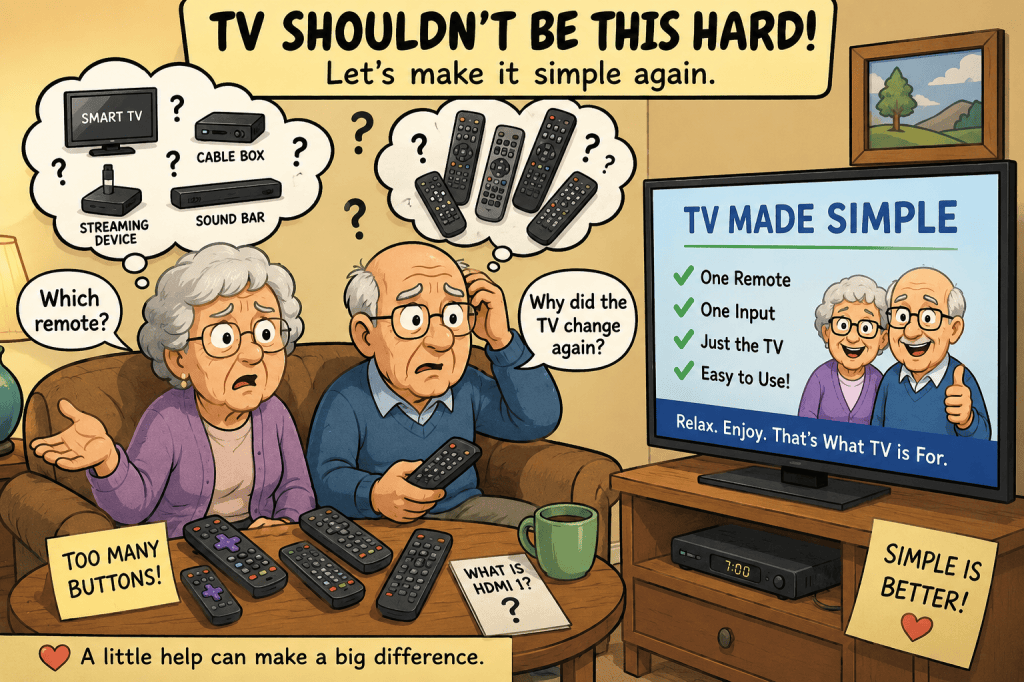
    Instead of one device, many homes now have:

    • A smart TV
    • A cable or satellite box
    • A streaming device (Roku, Fire TV, or Apple TV)
    • A sound bar
    • Multiple remote controls

    Just turning on the television can require pressing the correct buttons in the correct order.

    “It Was Working Yesterday”

    One of the most common things I hear when helping clients is:

    “I didn’t touch anything. It just stopped working.”

    Often, nothing is actually broken.

    Someone accidentally changed the TV input.
    The cable box is off.
    The TV is now on a streaming app instead of cable.
    The wrong remote was used.

    These are easy problems to fix if you’re comfortable with technology. But if you’re not, they can make the television feel unusable.

    Too Many Buttons

    Many remote controls have 40 to 60 buttons.

    Most people regularly use only a handful:

    • Power
    • Volume
    • Channel Up/Down
    • Mute

    Everything else can become a source of confusion. One accidental press of the “Source,” “Home,” or “Input” button can make it seem like the TV has stopped working altogether.

    The Hidden Menus

    Modern TVs are no longer just televisions—they’re computers.

    Instead of simple channel numbers, you’re greeted with rows of apps, recommendations, advertisements, and menus. Finding live television may require navigating through several screens before you ever reach your favorite channel.

    For someone who simply wants to watch the evening news, that’s a lot of unnecessary complexity.

    Technology Changes Faster Than We Do

    Many seniors spent decades mastering one way of doing things. Then every few years, the technology changes again.

    Cable becomes streaming.
    Streaming changes its menus.
    Remote controls are redesigned.
    Software updates move familiar settings to new places.

    Even people who were comfortable with technology ten years ago may find today’s systems unfamiliar.

    The Good News

    The good news is that most of these problems can be solved.

    A television doesn’t have to be complicated.

    In many cases, it can be simplified so that:

    • Only one remote is needed.
    • The TV always turns on to the correct input.
    • Unused apps and menus are hidden.
    • The buttons that matter are easy to find.
    • The entire experience becomes predictable again.

    Sometimes a few small adjustments can make a television feel familiar and enjoyable instead of frustrating.

    Technology Should Help, Not Intimidate

    Technology is at its best when it fades into the background. Watching your favorite movie, the local news, or a baseball game shouldn’t require troubleshooting or remembering a sequence of button presses.

    For many older adults, a little patient help can restore the confidence to enjoy television again.

    Sometimes the solution isn’t buying a new TV—it’s making the one you already own simpler to use.


    At HomeTechCare, I believe technology should make life easier, not harder. Whether it’s simplifying a television, organizing remote controls, improving Wi-Fi, or helping with computers and smartphones, my goal is to make technology feel approachable again—one visit at a time.