That Smoke Alarm on Your Ceiling Has an Expiration Date
Why smoke and carbon monoxide alarms wear out—and why pressing the test button isn’t the whole story
I recently learned something about one of the most important safety devices in our homes that I honestly had never thought about before:
Smoke alarms and carbon monoxide alarms do not last forever.
I knew batteries went bad. I knew we were supposed to test the alarms occasionally. But I had always thought that if the alarm had power and the test button made it beep, the device itself was probably fine.
That isn’t necessarily true.
The sensors inside smoke and carbon monoxide alarms age. Their components deteriorate. Dust, humidity, temperature changes and years of continuous operation all take their toll. Eventually, the alarm itself needs to be replaced—not just the battery.
Considering what these small devices are expected to protect us from, that’s something every homeowner should know.
Smoke alarms generally have a 10-year life
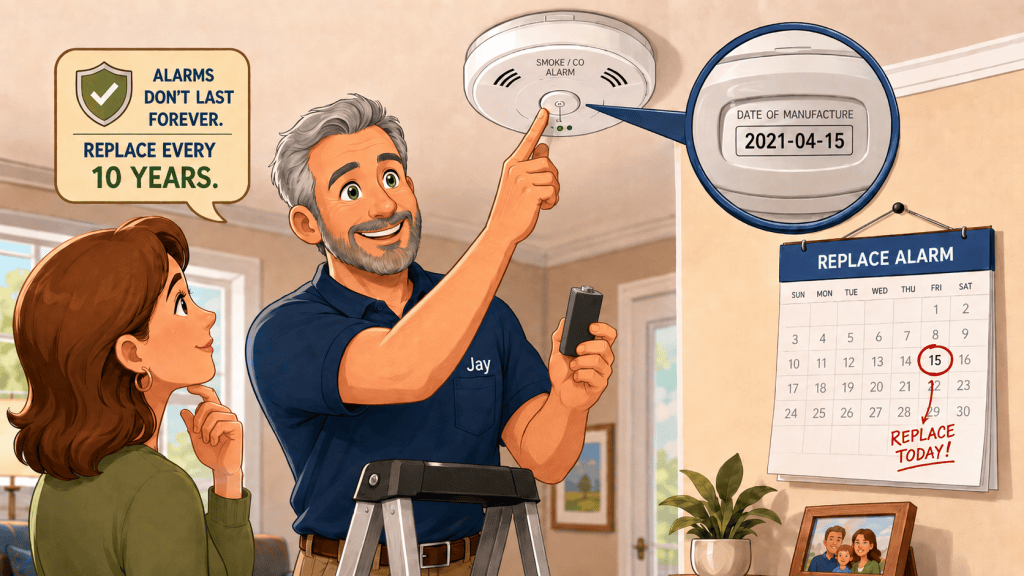
The U.S. Fire Administration recommends replacing smoke alarms 10 years from their manufacture date. That applies even to hardwired alarms.
Carbon monoxide alarms are somewhat different. Older CO alarms commonly had expected service lives of five to seven years, while many newer models are designed for longer periods, sometimes up to 10 years. Combination smoke/CO alarms also vary by model.
The important number isn’t necessarily the day you installed it. It’s the manufacture or replacement date printed on the alarm.
Your own alarm should tell you when it needs to be replaced. Take it down from the wall or ceiling and look at the label on the back.
The safest rule for CO and combination units is simple: follow the replacement date specified by the manufacturer.
Smoke alarms, meanwhile, should generally be replaced once they reach 10 years of age. The U.S. Fire Administration specifically warns that smoke alarms do not last forever.
Why do they wear out?
A carbon monoxide alarm usually contains an electrochemical sensor. In very simplified terms, CO entering the sensor produces a chemical reaction that generates an electrical signal. The alarm measures that reaction and determines whether the amount of carbon monoxide has reached a dangerous level.
But chemistry changes with time.
The electrolyte and other components in the sensor gradually deteriorate. Temperature, humidity, contaminants and years of exposure to the surrounding environment can affect its performance. Eventually the sensor can no longer be depended upon to measure carbon monoxide accurately.
Smoke alarms age as well. Their sensing chambers can accumulate contamination, electronic components age, and their ability to reliably distinguish smoke can deteriorate.
The Consumer Product Safety Commission has specifically warned that alarm sensors lose effectiveness because of environmental contamination and age.
This isn’t a manufacturer’s trick to sell another alarm. It’s simply the reality of electronic and chemical sensing equipment that has been operating continuously for years.
Guess what?
Pressing the TEST button does not necessarily prove that the CO sensor itself is still accurately detecting carbon monoxide.
According to the Consumer Product Safety Commission, the test button confirms that the alarm’s circuitry is operating correctly. It does not verify the accuracy of the CO sensor.
That’s an important distinction.
An alarm can beep perfectly when you press TEST and still be beyond its manufacturer’s recommended service life.
That’s why checking the date matters.
How often do smoke alarms actually fail when there is a fire?
More often than I expected.
The National Fire Protection Association studied U.S. home fires from 2018 through 2022. Fire departments responded to an estimated 19,119 home fires every year in which smoke alarms should have operated but failed to do so.
Those fires resulted in an annual average of approximately:
403 deaths and 1,052 injuries.
Over a ten-year period at that rate, that would represent roughly 191,000 fires, 4,000 deaths and more than 10,000 injuries involving homes where an alarm should have sounded but didn’t.
NFPA also found that nearly three out of five home-fire deaths occurred in properties where there was either no smoke alarm at all or an alarm that failed to operate.
There is another important lesson in these statistics.
Old sensors aren’t the only problem.
In actual fires, NFPA found that missing or disconnected batteries, dead batteries and disconnected hardwired alarms were among the most common reasons alarms failed.
So there are really two issues we need to pay attention to:
Is the alarm powered and working today—and is the alarm itself still young enough to be trusted?
Carbon monoxide is a much larger problem than many people realize
Carbon monoxide is particularly dangerous because our senses provide almost no warning.
You can’t see it.
You can’t smell it.
And symptoms such as headache, dizziness, weakness, nausea and confusion can easily be mistaken for illness, fatigue or something else.
The latest CDC consumer guidance says that every year in the United States, more than 400 people die from unintentional carbon monoxide poisoning not associated with fires, more than 100,000 people visit emergency departments, and more than 14,000 are hospitalized.
Put those annual numbers into perspective over ten years and they represent more than:
1 million emergency-department visits, 140,000 hospitalizations and 4,000 deaths.
Those are people, not households. There isn’t a reliable national statistic that tells us exactly how many individual families experience a CO leak each year because a single incident may expose one person or an entire household.
But the scale of the problem is clear.
Furnaces, fireplaces, gas water heaters, generators, vehicle exhaust and other fuel-burning equipment can all produce carbon monoxide under the wrong conditions.
A working CO alarm may be the only warning a family receives.
Smoke remains an enormous household hazard as well
There isn’t a national statistic specifically counting “families affected by smoke infiltration.” Fire agencies instead track fires, deaths and injuries.
Those numbers provide some perspective.
From 2014 through 2023, the U.S. Fire Administration estimates that American residential buildings experienced approximately 3.67 million fires.
During that same ten-year period, those residential fires caused approximately 27,485 deaths and 113,425 injuries.
And this isn’t only about flames.
A U.S. Fire Administration analysis of residential fire fatalities found that thermal burns and smoke inhalation together were the primary symptoms leading to death in 89% of residential fire fatalities.
In 2024 alone, NFPA estimated 329,500 home structure fires, causing about 2,920 civilian deaths and 8,920 injuries. That’s approximately one reported home fire every 96 seconds.
Working alarms give occupants something they desperately need when that happens:
Time.
Take five minutes and check yours
This is one of those home-maintenance jobs that takes almost no time and costs very little compared with what is at stake.
Today, take a look at the smoke and CO alarms in your home:
- Take each alarm down and find the manufacture or replacement date.
- Replace smoke alarms that have reached 10 years of age.
- Replace CO and combination alarms according to the date and instructions on the unit.
- Test every alarm monthly.
- Replace conventional batteries as recommended, and never remove a battery simply because an alarm is becoming annoying.
- Make sure you have adequate coverage—smoke alarms in bedrooms, outside sleeping areas and on every level, with CO alarms on each level and outside sleeping areas.
If you’re replacing alarms, interconnected units are worth considering. When one detects trouble, all of the interconnected alarms sound—which can be especially important if the problem begins in another part of the house while you’re sleeping.
The little white box we stop noticing
Smoke and CO alarms are easy to ignore.
Once they’re installed, they tend to become part of the ceiling or wall. We walk underneath them thousands of times without thinking about them.
Until we need one.
That’s probably the biggest thing I realized while looking into this: these aren’t permanent parts of the house. They’re safety devices with expiration dates.
A battery can be good.
The little green light can be on.
The test button can beep.
And the alarm can still be old enough that it should be replaced.
For something that may someday be responsible for waking you, warning your family and giving everyone enough time to get out of the house, checking the date seems like a pretty worthwhile five-minute job.
 HomeTechCare.us Articles
Leave a comment